Outlet level control of Nontuberculous Mycobacteria (NTM): what the evidence says about 0.2 µm sterilizing grade Point-of-use Filtration

Nontuberculous Mycobacteria (NTM) persist in building water systems due to their resistance to heat and disinfectants, posing infection risks especially in healthcare settings. Outlet-level Point-of-Use (POU) filtration with sterilizing-grade 0.2 µm membranes is critical to reducing exposure at taps and showers where aerosols form.
- NTM persistence and exposure routes: NTM thrive in premise plumbing biofilms and aerosolize at outlets, with species like Mycobacterium avium complex showing high chlorine tolerance, explaining their persistence in drinking water systems despite flushing efforts. [1] [2]
- Risks from ice and water equipment: CDC investigations linked Burkholderia multivorans infections to ice and ice-water machines in hospitals, recommending avoidance of tap water and ice for patient care during outbreaks, highlighting the need for safe water outlets and workflows. [3]
- Effectiveness of outlet-level controls: Disposable 0.2 µm POU membrane filters prevent mycobacteria passage effectively, unlike granular activated carbon filters which can promote biofilm regrowth; UV-C treatment adds benefit when combined with particulate removal. [4]
- Integration into safety plans: BS 8680:2020 Water Safety Plans endorse POU barriers as control points alongside flushing and disinfectant management; practical steps include mapping high-risk outlets, intelligent flushing, avoiding carbon filtration, and auditing sterilizing-grade filter claims. [5] [6]

Who this article is for
This article is intended for infection prevention and control (IPC) professionals, water safety leads, facilities managers, and clinical engineering teams responsible for managing water-associated infection risks in healthcare and other high-risk environments. It summarizes current scientific evidence on Nontuberculous Mycobacteria (NTM) in building water systems and explains why outlet-level, Point-of-Use (POU) filtration plays a critical role in reducing exposure at taps and showers.
Why NTM persist - and why outlet level barriers matter
Nontuberculous Mycobacteria (NTM) are environmental organisms that thrive in premise plumbing biofilms and can be aerosolized at taps, showers, or device water circuits - creating exposure routes for clinically relevant species such as the Mycobacterium avium complex (MAC), M. abscessus, and M. chimaera [1, 2]. Their lipid-rich cell envelope and capacity to form biofilms underpin notable tolerance to heat and disinfectants [2].
Compared with the traditional microbial “yardstick” (E. coli), Mycobacterium avium shows markedly higher chlorine tolerance (often ≥100 to 500 fold under defined conditions), helping explain persistence in drinking water systems [3, 4].
Stagnation and low disinfectant residuals are repeatedly associated with higher NTM levels at outlets; flushing helps, but the required flush times differ by building and season - one reason why single, system wide measures struggle to deliver consistent, patient adjacent risk reduction [5, 6].
A cautionary signal from ice and ice water equipment
The CDC documented multi year clusters of Burkholderia multivorans infections linked to ice and ice water machines across four U.S. hospitals (2020–2024). In outbreak settings, the CDC advises avoiding tap water and ice for patient care [7].
This lesson learned applies broadly to water associated organisms and underscores the importance of safe outlets and robust clinical workflows.
What works at the outlet (POU membranes vs. carbon)
Reviews of physical control measures show that disposable 0.2 µm POU membranes prevented the passage of tap water–adapted mycobacteria over test periods, whereas granular activated carbon (GAC) systems failed to significantly reduce M. abscessus and M. avium—consistent with biofilm formation and regrowth tendencies in carbon matrices [8]. UV C can provide an additional effect when upstream particulate removal is ensured [8].
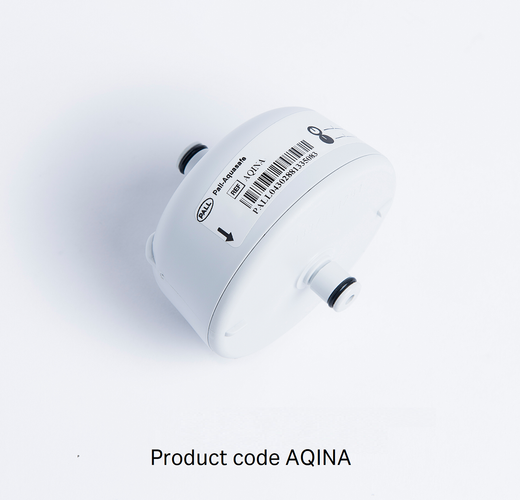
Standards validation: Pall Medical/Cytiva demonstrates sterilizing grade performance to ASTM F838 20 for Aquasafe™ and QPoint™ POU filters (Brevundimonas diminuta ≥10⁷ CFU/cm²), with defined specifications for pressure, temperature, and service life - providing a clear, auditable product claim [9].
Integrating POU into Water Safety Plans (WSP)
BS 8680:2020 is the authoritative Code of Practice for Water Safety Plans in buildings, covering governance, risk assessment, control schemes, monitoring, and documentation. POU barriers can be embedded as defined control points at the outlet-complementing flushing regimes, temperature management, and disinfectant residual control [10].
Practical playbook (checklist)
- Map outlets and risk (aerosol generating, patient adjacent); selectively install POU barriers at high risk locations [8, 9].
- Flush intelligently (building and season specific; objective: restore disinfectant residuals) [5].
- Avoid tap water and ice for clinical care during outbreak situations [7].
- Avoid carbon filtration for NTM reduction; consider POU + UV C (with appropriate pre filtration) [8].
- Audit claims: look for ASTM F838 20 sterilizing grade POU membranes and clearly defined operating specifications [9].
Conclusion
NTM risk materializes at the outlet-precisely where aerosols are generated and patient contact occurs. The evidence supports sterilizing grade 0.2 µm POU membranes as an immediate, standards validated barrier, combined with flush and residual based system measures within a BS 8680 compliant Water Safety Plan [8–10].
References
- Honda JR. Environmental sources & transmission of NTM. Clinics in Chest Medicine. 2023.
- Gan Y, Rahmatika I, et al. NTM fate and risk in water supply systems. H2Open Journal. 2022.
- Taylor RH, Falkinham JO, et al. Disinfectant susceptibility of Mycobacterium avium. Applied and Environmental Microbiology. 2000.
- Falkinham JO. Factors influencing chlorine susceptibility of MAC. Applied and Environmental Microbiology. 2003.
- Dowdell KS, et al. Source to tap investigation: stagnation, residuals, flushing times. Applied and Environmental Microbiology. 2024.
- Rahmatika I, et al. Stagnation, NTM diversity and chlorine tolerance. Water Supply. 2023.
- CDC. Ice and ice water machine-associated outbreaks. MMWR. 2024.
- Norton GJ, et al. Physical measures to reduce exposure: POU membranes vs. GAC; UV C. Frontiers in Public Health. 2020.
- Cytiva (Pall Medical). Aquasafe™ / QPoint™ POU filters - ASTM F838 20 validation.
- BS 8680:2020. Water Safety Plans - Code of practice.
Author bio
Darina Schmidt, Global Demand Generation Manager Medical – Water
Darina is part of the medical water portfolio and marketing team. covering the medical water portfolio. She has knowledge in Marketing Communications and brings insightful current industry trends.
Download the NTM Brochure and Get in Touch
Our water filters for healthcare